


EcoStewards Conservation Technician
CCRCD and The Watershed Project staff building a willow plant mat at Rheem Creek at a workshop hosted by The Watershed Project
When the rainy season rolls around, community members who live by creeks wait with looming fear over streambank erosion. Most of the year, California's climate is temperate, with dry, hot summers and mild, wet winters. However, some winters are much wetter, which can cause problems for our urban creeks. Long dry spells, followed by intense downpours, can cause creekbanks to become saturated in water, potentially leading to erosion. To remedy this, we can turn to soil bioengineering. Soil bioengineering is a nature-based technique of using native plant material and soil, rather than concrete or rock, to stabilize creek banks.
While the phrase “soil bioengineering” may sound technical and inaccessible to the average person, with the right permits and background knowledge, anyone can do it! A common practice in soil bioengineering is harvesting dormant willow branches. Willows have fast growing roots that can hold soil together, adding supportive structure to the foundation of creek banks. They also provide a food source for native animals and shade to keep water temperatures cool. The willow branches are cut into 3 foot stakes, which are then hammered into the ground in order for the willow to develop roots.
The Contra Costa Resource Conservation District (CCRCD) team recently participated in a soil bioengineering workshop hosted by The Watershed Project. The workshop was held at Rheem Creek in the City of Richmond. Everyone involved in the workshop had a chance to hammer willow stakes and plant native riparian vegetation.
Concrete retaining walls and rip-rap rocks are more common for urban creek bank stabilization, however they provide no ecological benefits and could cause more harm by altering the flow of the creek. A nature-based solution is less expensive than concrete and easier for homeowners to do on their own. With funding from the Contra Costa County Flood Control District, the California Urban Streams Partnership (CUSP) created the Streamside Management Program for Landowners (SMPL), which provides free assistance to property owners along creeks with erosion and flooding issues. Next time you are near your local creek, take a look to see if it’s in need of soil bioengineering!
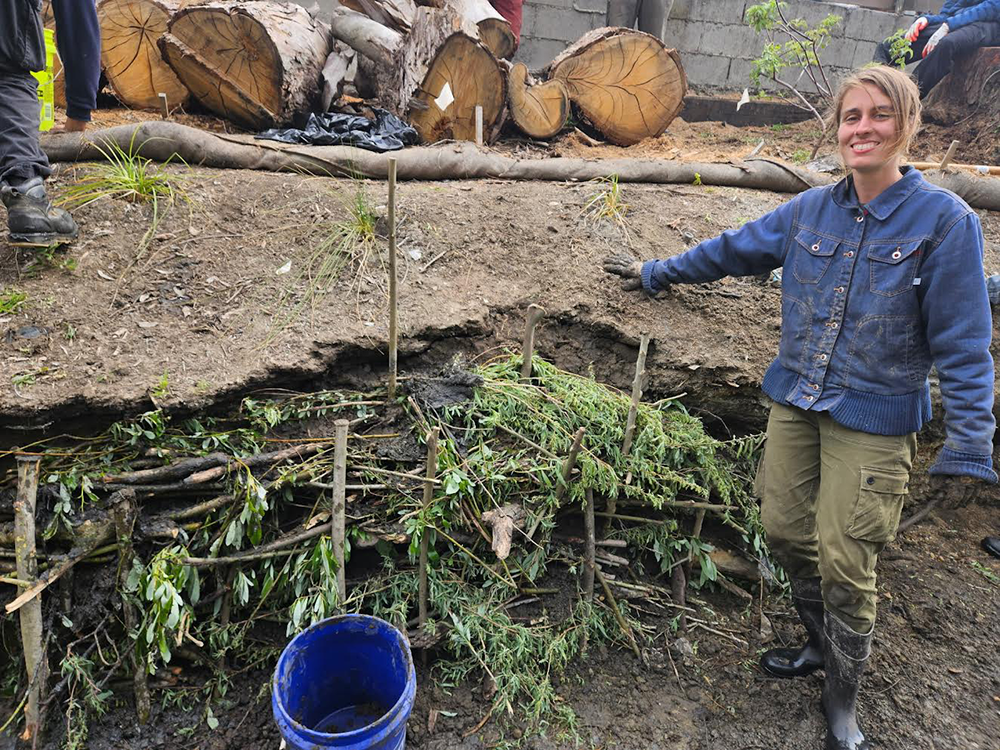
CCRCD staff member Molly Clemons standing next to a nearly completed willow plant mat at Rheem Creek.